
The annual drop of the WARC Future of Strategy report is always a useful bellweather on industry shifts. Whilst it focuses heavily on “advertising and marketing agencies”, it’s still a useful insight into broader sentiment around how strategy is often perceived and received.
This year’s report (as did last years) paints a picture of anxiety, certainly a crisis of confidence, and demonstration of the failures of the commercial models around how strategy is often charged for (or valued) within agencies, along with data to show not just how the population of strategy folk within agencies has declined, but how next year, that is set to continue.
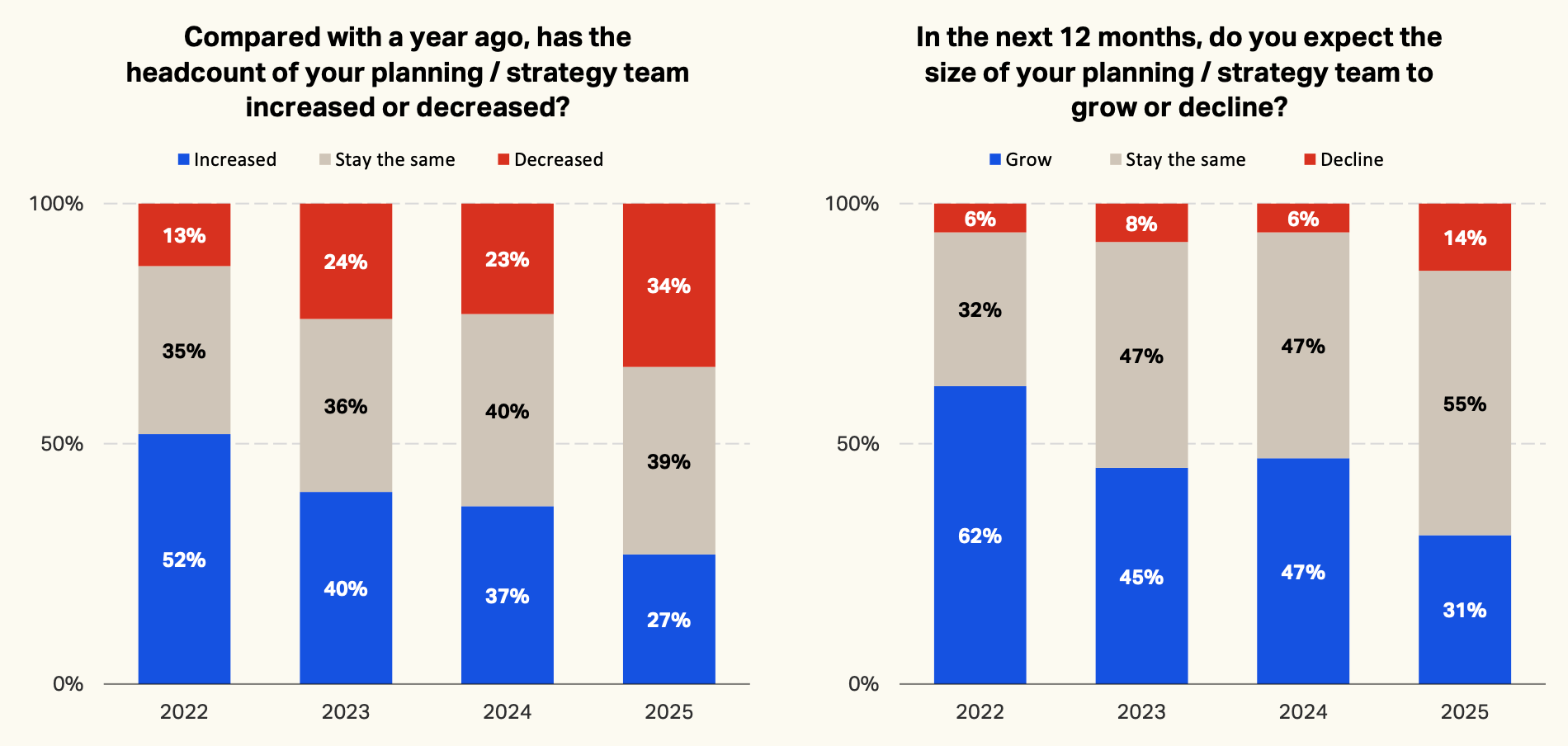
14% of respondants (and it’s a well engaged study) said they’re set to make even further headcount cuts across strategy teams next year - after, what has already been 12+ months of brutal downsizing across many businesses, where strategy often is one of the first to get slashed.
My conversations with strategy leaders (i.e. heads of strategy, CSO, agency leaders) will often have the same few themes: 1) we’re running a very lean team and our people are stretched 2) the budgets and timeframe for strategy are squashed to practically ineffective and 3) rapid response thinking is required, and tools to enable that (like AI) are essential, not a luxury.
And you may have seen my post on the very real impact that’s also having on people who are being unceremoniously pushed out of roles.
There’s lots of looking back with rose-tinted glasses on a better time, where we had weeks to explore, but there’s also an acceptance that we’re likely never returning to that.
However, that’s the view from inside agencies (moreso in the larger ones).
The WARC report also hints at the shift towards the world we inhabit - independence.
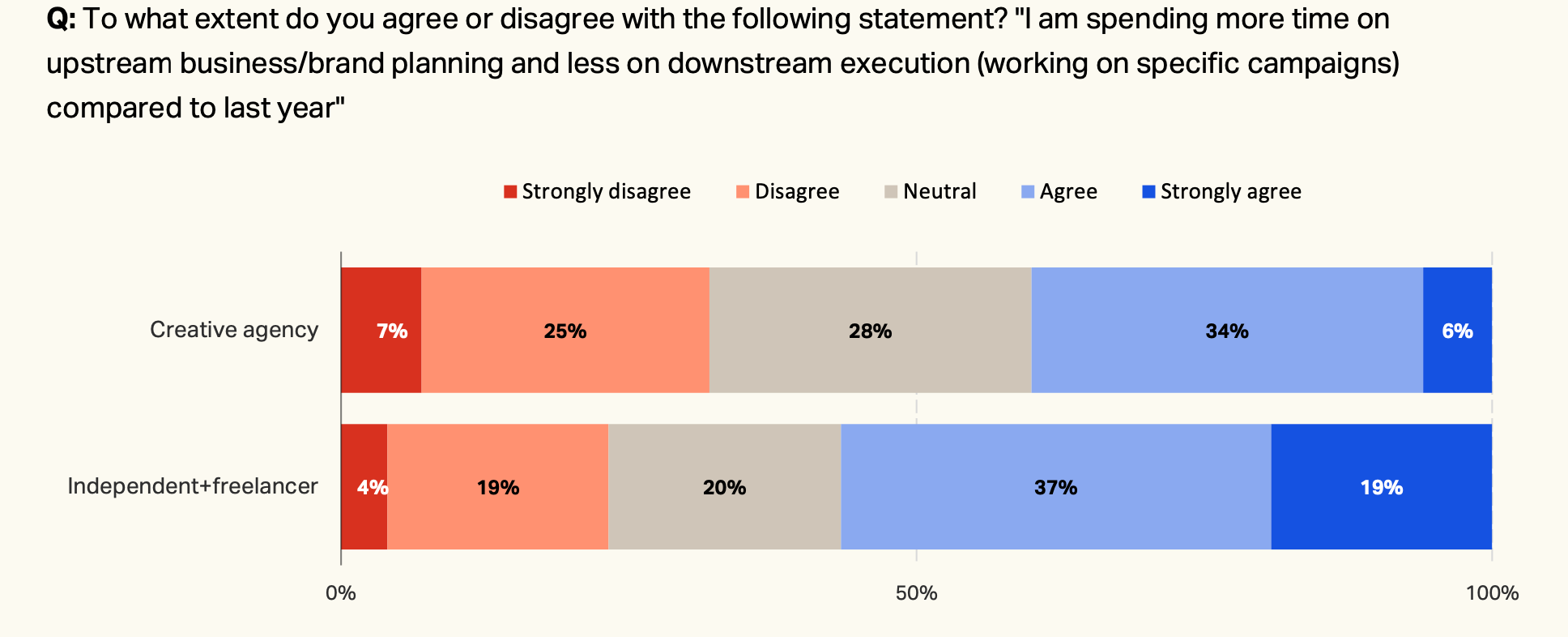
Some 46% of independent or freelance strategy folk are saying they’re spending more time on upstream strategic work, where creative agency folk are seeing a decline in that type of work.
Whilst any self-reported data like this needs to be taken with a little pinch of salt - there is an undeniable truth that:
There’s been a huge flow of talent into independent strategy spaces in recent years, and that means clients are able to access a wider group of brilliant people, rather than only “available” via an agency.
There’s been a substantial growth in the number of strategy-first businesses popping up, microstudios, collectives, networks, teams of one - who have an entirely strategy-led value proposition, which is solution agnostic and impartial.
When clients actively choose a strategy-led partner, they’re very openly recognising the value of strategy, when it’s done in the right way: decoupled from a pre-determined solution; and given the space to breathe and go a little deeper. That doesn’t mean endless noodling. The new strategy-first businesses are already putting pace in place, and offering focus and efficiency AND depth and quality.
If the data the industry uses is only really coming from agency people - perhaps the “strategy in crisis” headlines are only from the perspective of more traditional agency models, rather than smarter, nimbler and modern independent models.
And I think there’s far more optimism to be had in that space.
Matthew.
ps. Don’t forget - our annual survey on mental health in self-employment is open now. We need as many people to take part as possible. If you’ve already participated, thankyou! Please encourage your network to do the same.
Don’t worry, we’re not launching a dating platform - but of Sibling Studio is working on a new report, exploring modern dating, and needs your input.
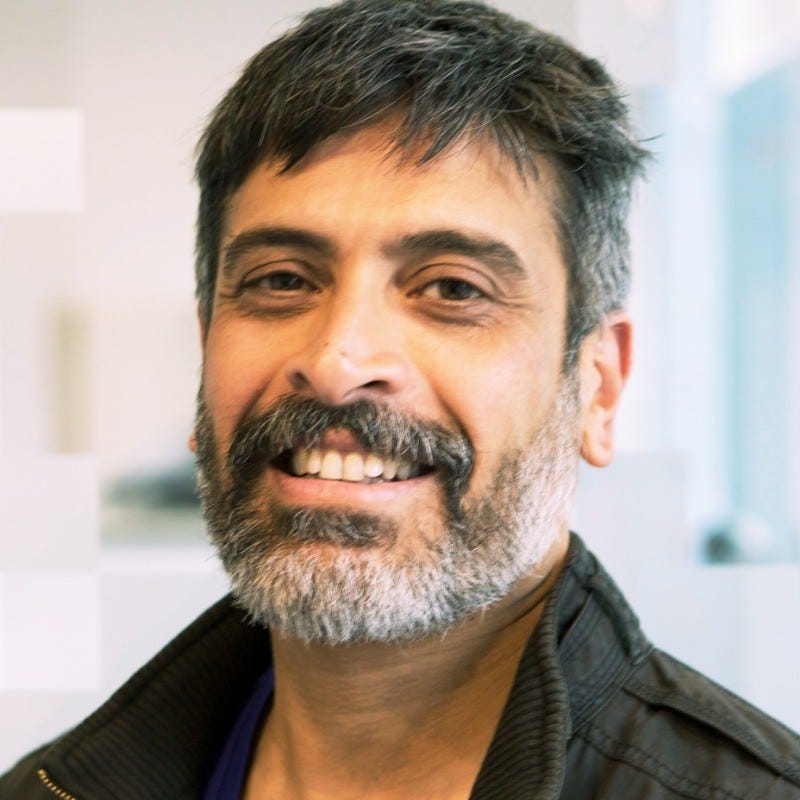
I spoke to Juggi Ramakrishnan, award winning creative veteran and curator of the Deck of Brilliance, a collection of over 200 creative tools.
Juggi, what is the Deck of Brilliance?
The Deck of Brilliance is the world’s largest and most popular collection of creative tools (202 and counting) built to help you break through creative block and generate lots of ideas quickly, inspire you with examples from around the world, and equip you with the understanding and insights needed to sell or defend your work.
Although originally designed for creatives, the deck has also gained popularity among planners and marketers. At its core, it’s not just about inspiration. The deck is like an anatomy book for ideas. It reveals the bones and muscles beneath the surface and shows how great ideas really work.
I’ve been in the ideas business for close to 35 years. I learned early on that success is a volume game. The more ideas you start with, the better your final choices, and the more confident you can be.
So even back then, I began building a set of tools just for myself. At first, they were simply ways to jolt my brain out of autopilot.
Fast forward to 2012. I’d moved to Beijing and was leading a team of creatives. Many of them were smart, talented, and deeply familiar with storytelling. But I noticed they hadn’t been exposed to the full range of what advertising could be. So I started running weekly “exposure sessions” using my tools to broaden their perspective.
What began as a small internal habit gradually grew into something much bigger. Before long, I was giving lectures across various Ogilvy offices. In 2016, with a nudge from my colleagues Todd McCracken and Graham Fink, I decided to take the plunge and share the tools publicly. Todd helped build the first official version of the Deck of Brilliance that same year.
In 2025, nearly a decade later, I finally gave the deck the major upgrade and expansion it had long deserved.
There’s a growing sense that creative work today lacks bravery or a big idea. Most work seems focused on short-term wins rather than standing out. How can brands bring back real creative differentiation in the age of micro-attention and doomscrolling?
It’s true. Marketers today are stuck in systems that reward short-term wins. But real brand-building takes patience. It can’t be measured week to week.
You can’t escape the short-term trap entirely. So the key, in my view, is balance.
Marketers need to treat each campaign as part of a bigger story, not just a single push. Play the short game to keep the results coming, but keep investing in the long game so the brand still lives in people’s minds long after the campaign ends.
And creatives can do their part too, by pushing for ideas that feel bold enough to last.
When everyone else is optimising for the scroll, ask, will this still matter next year?
Most creatives and strategists are super stretched for time. The space for genuine creative exploration feels increasingly rare. What’s the answer?
Unfortunately, we’re living in an era where most creative agencies are owned by holding companies whose real money comes from placing media, not from selling ideas.
In many agencies, ideas are given away for free.
That devalues creative people across the industry.
If you’re working at a big agency, don’t hold your breath waiting for them to give you more time to explore.
The truth is, creatives in this system are cows in a milking shed. And the bean counters couldn’t care less about pasture time.
In that system, compliance, not brilliance, becomes the ultimate virtue. Anyone defending their work with real passion will eventually be replaced by someone more compliant.
What’s the answer? I don’t know for sure.
What I do know is this. If you’re freelancing, protecting your mental health is your responsibility.
You have to adapt. Learn to be twice as productive in half the time. Present only the work you’re proud of.
And look outside the advertising world for your inspiration.
» There’s a longer version of my conversation with Juggi here, and you can connect with him on LinkedIn here, or find the Deck of Brilliance here.
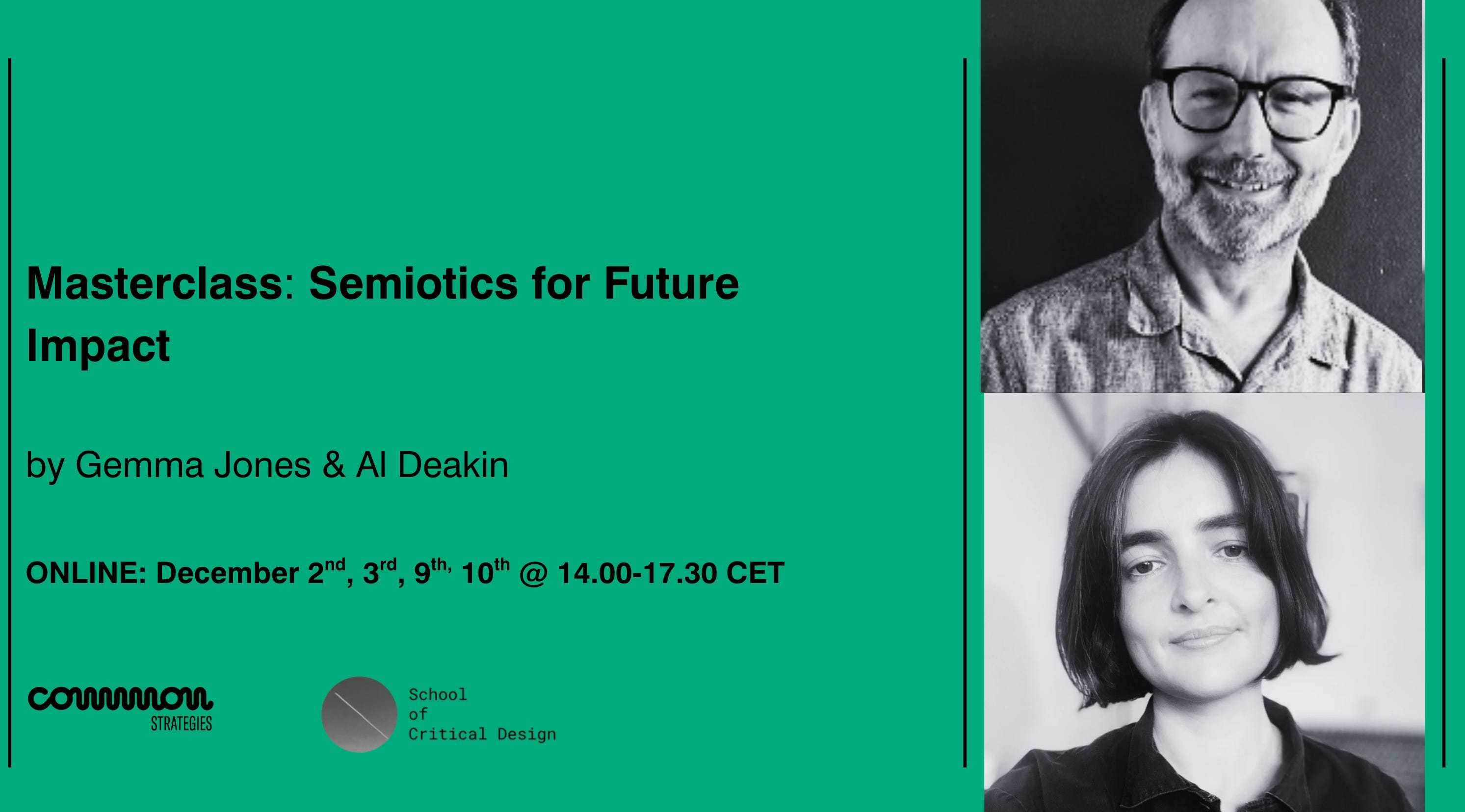
» Gemma Jones and Al Deakin are hosting a masterclass on semiotics for future impact. Designed for people who want to do good work for brands and organisations, and engage deeply with how this work makes the future. Think - soulful, critical and ambitious! An essential skill in strategic and creative work and necessary if we want to impact futures. More here.
» Emily Penny’s new newsletter. sign up here.
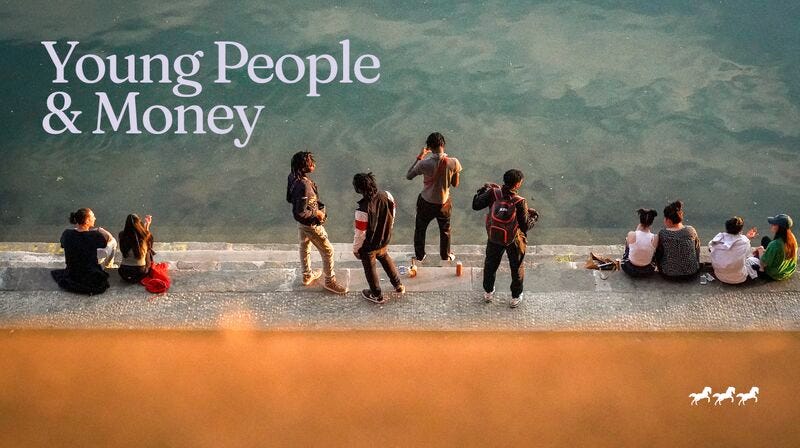
» David Akerman’s new drop on young people and money
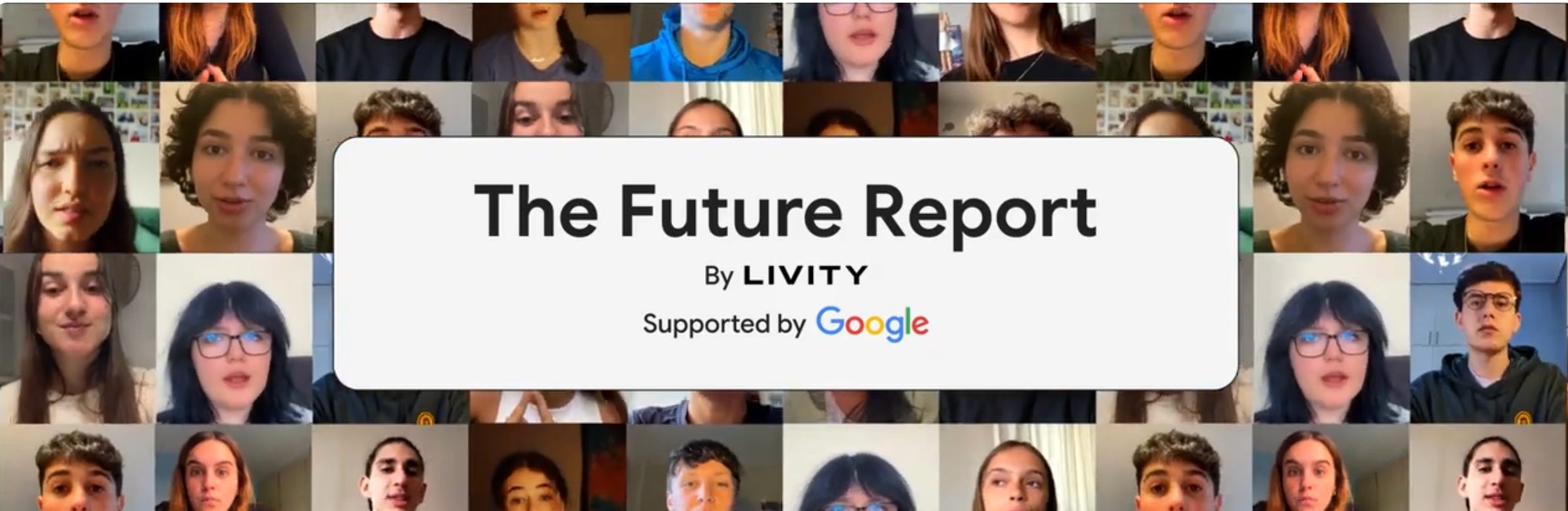
» Livity’s Future Report ( 👏 Dimitris Tsoutsos)
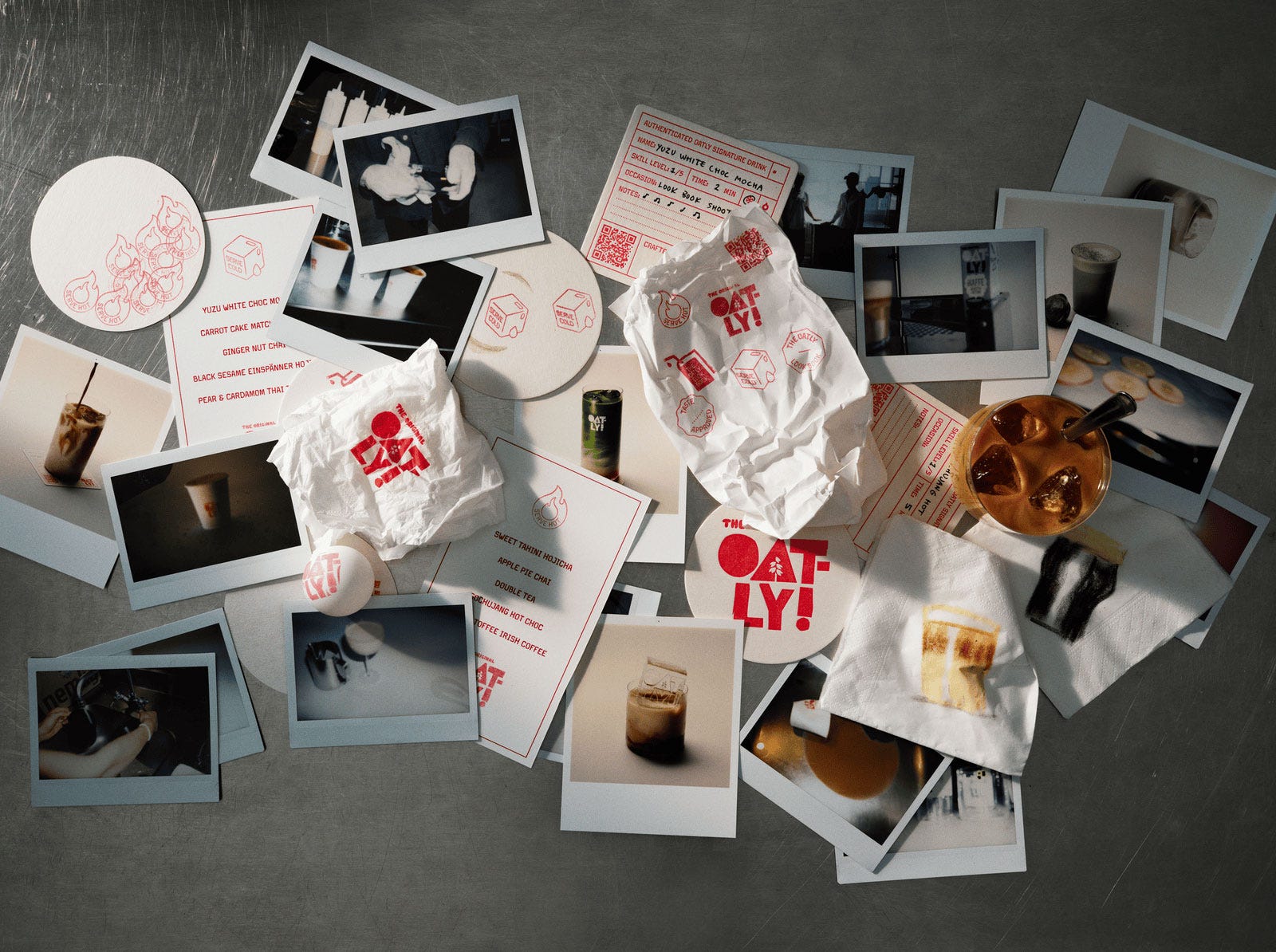
» Oatly’s Future of Taste report
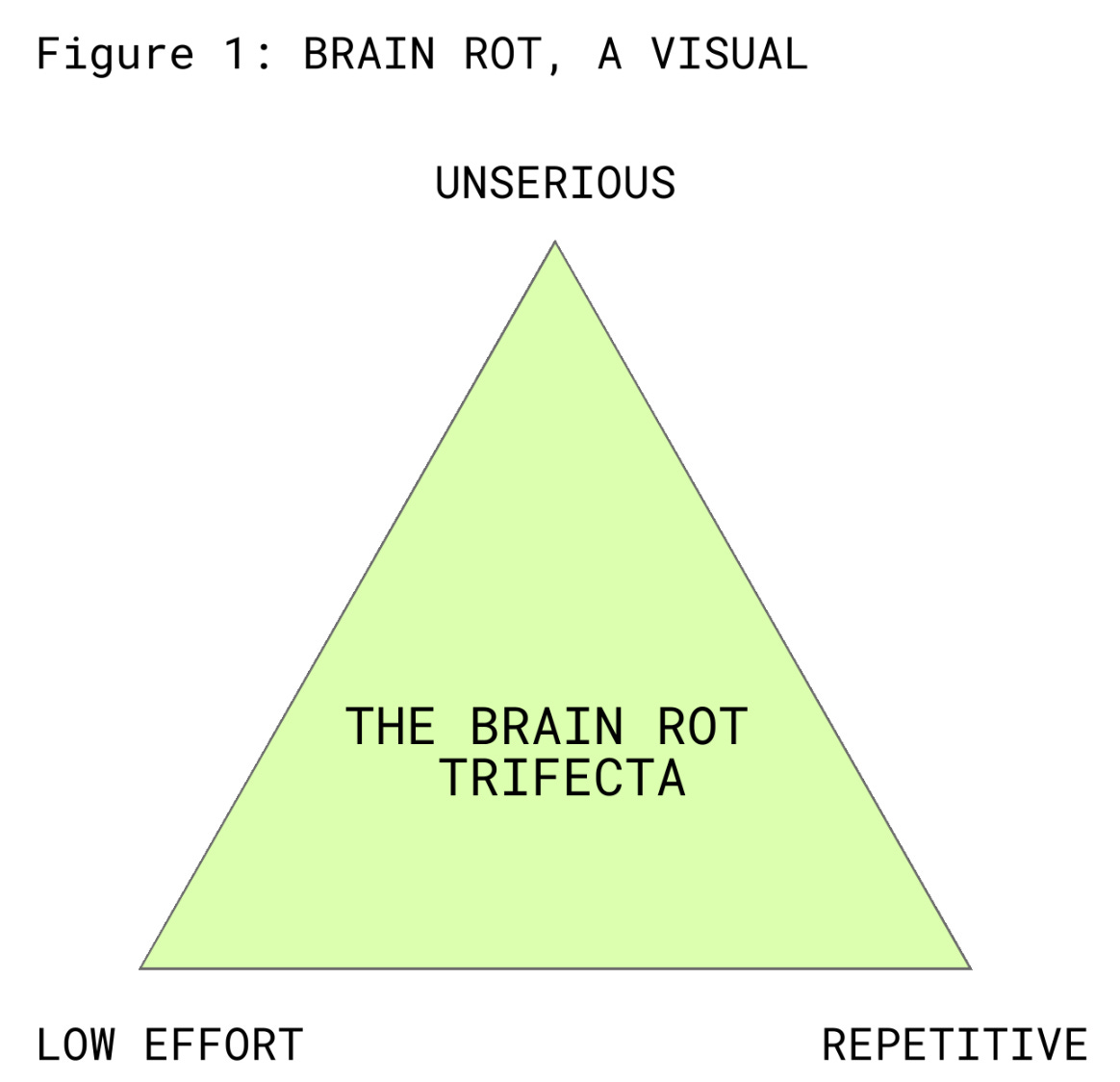
» On brain rot - thoughts from Natalie Podaima
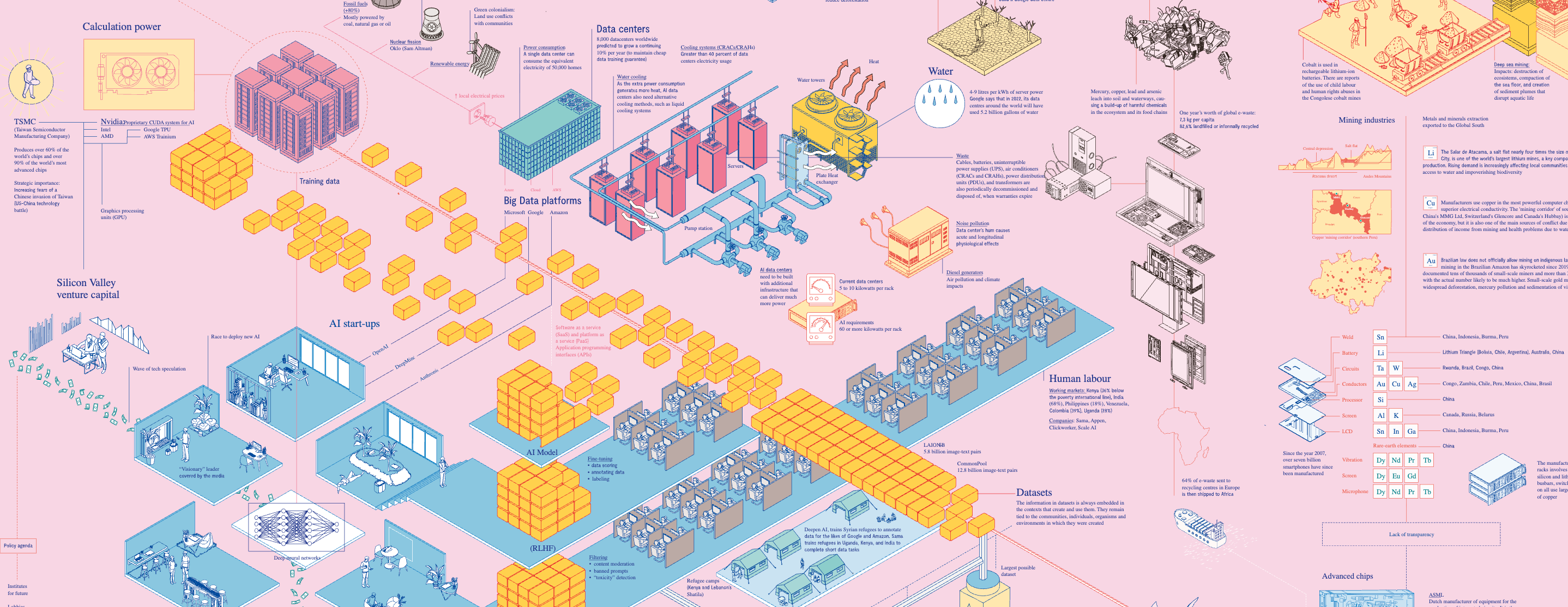
» The cartography of AI - from artistic collective Estampa
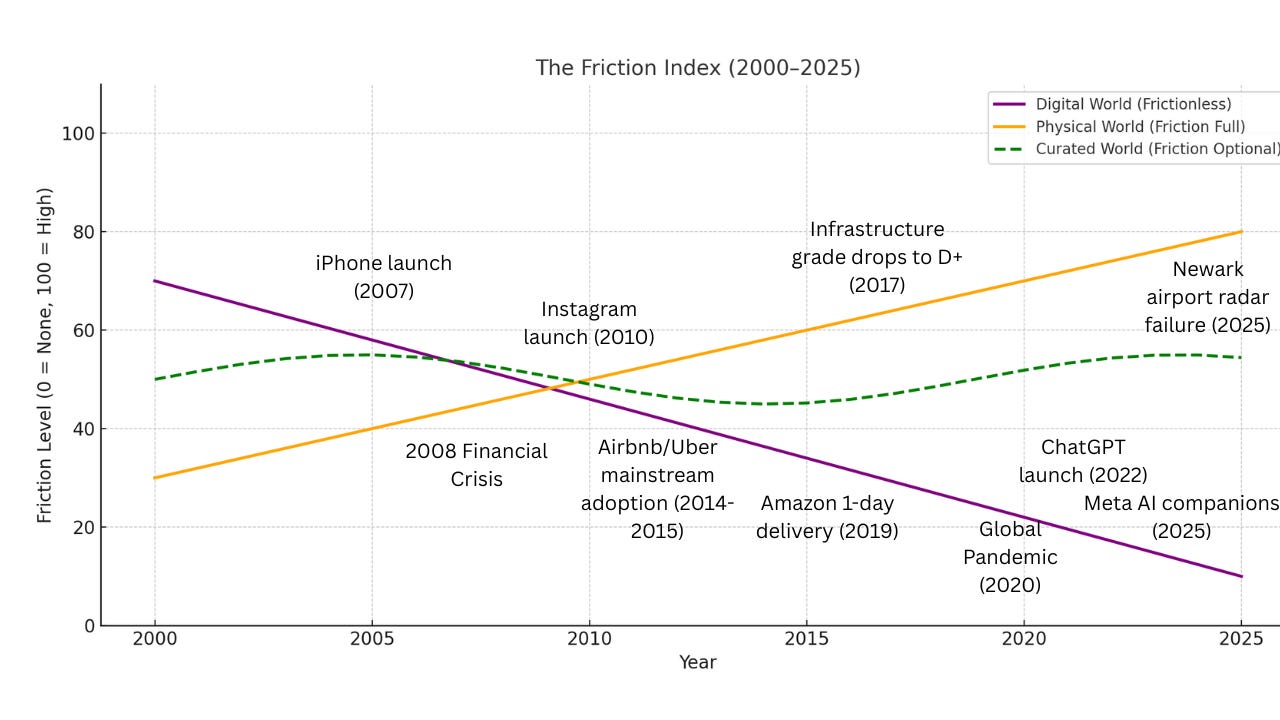
» Friction as luxury - from
» ’s new newsletter
» Semiofest 2026 have a call for contributions
» Love the Work More - archive of cannes lion winning creative work.
» Insightful thinking on studios as third spaces from Adrian Jarvis
» Tackling workplace loneliness
» Neil Perkin on AI + Strategy
» Missing words for the future
» The last days of social media
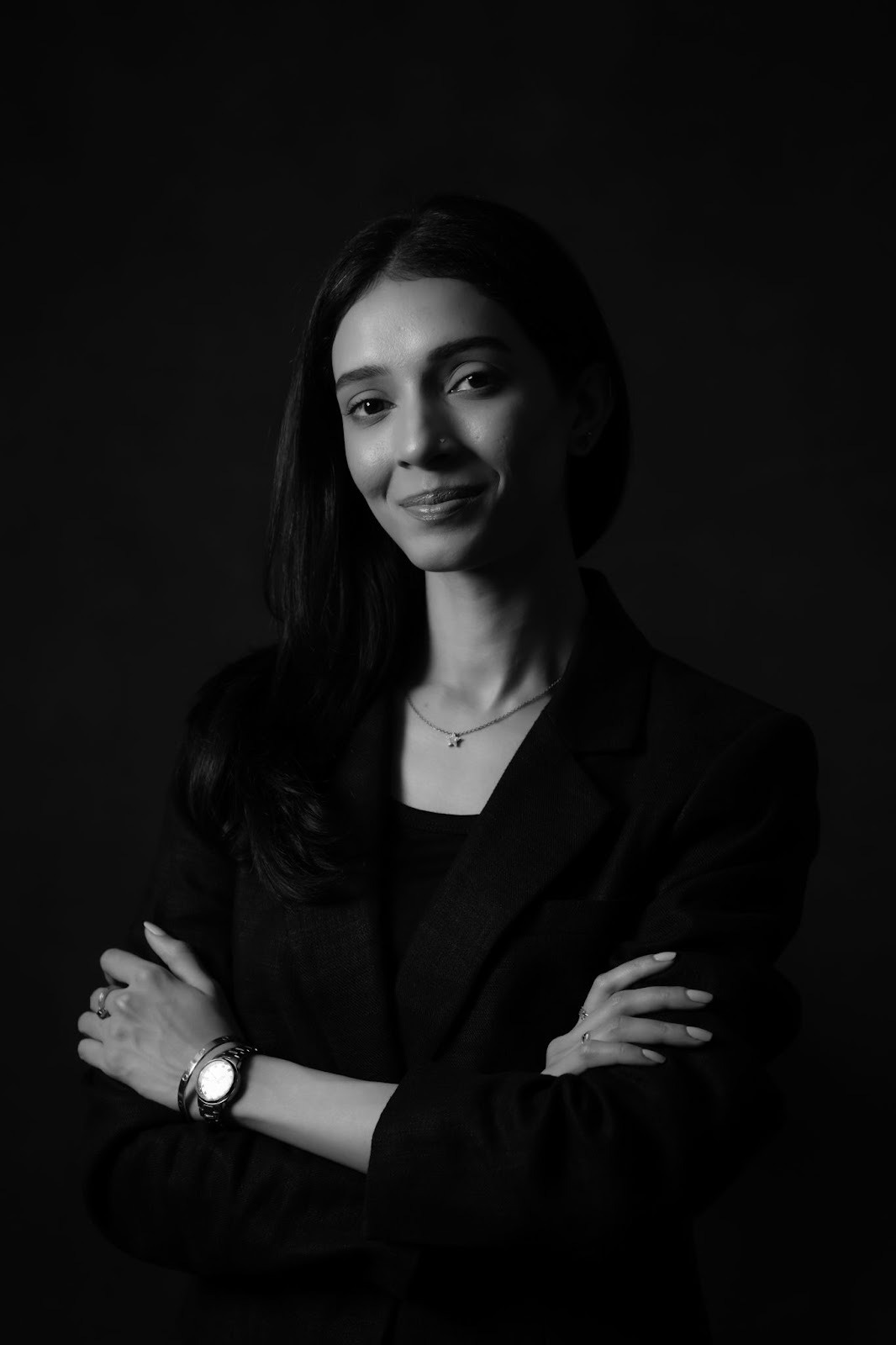
👋 Hi I’m Saliha, born in London, raised in Karachi, a brand architect and strategist focused on helping brands find their voice, connect meaningfully with their audiences.
I build cultural and commercial relevance through insight-driven strategy and multi-channel storytelling. My work often sits at the intersection of brand, communication, and cultural insights - shaping not just what brands say, but what they stand for and how they show up in the world.
I began my journey at Interflow Communications, one of Pakistan’s oldest and most celebrated advertising agencies, crafting communication strategies for large-scale national campaigns. My next stint was at Bullseye DDB, a partner of the global advertising group DDB in Pakistan, where I saw how the right blend of strategy and brand activation can turn ideas into experiences that resonate deeply.
For the past few years, I’ve been working independently, partnering with agencies, brands, and founders to build strategies that move beyond the brief, shaping narratives, innovating in communications and laying the foundations for enduring brand worlds.
One of the projects I’m particularly proud of is a recent collaboration with Hydrostor Inc., a renewable energy company pioneering long-duration energy storage solutions. I was brought on board as a brand strategy consultant at Summer Bunker, a strategic marketing consultancy in Portland, Oregon, focused on climate technology and other rapidly evolving industries, where I contributed to the brand and product naming exercise and language development process.
This included research and insight mapping to understand cultural nuances, market perceptions, and messaging patterns, exploring strategic naming territories to inspire creative direction.
The project reinforced my belief in the power of strategy to shape creativity, grounding innovation in context and crafting language that makes complex ideas feel relevant, human, and future focused.
I’m interested in work that pushes the boundaries of traditional brand strategy, shaping not just what brands say, but what they stand for helping brands cut through the clutter and create actual impact. In recent years, I’ve found personal satisfaction in giving back to the world through communication and going forward, I want to bring my skills and strategic thinking to areas like renewable energy, environmental innovation, and education - sectors where communication can drive meaningful change.
That means working upstream with founders, agencies, and creative teams to build brands from the ground up and shape narratives at the product and innovation level towards green marketing. My aim is always to enable creative ideas that resonate culturally while driving both commercial impact and societal change.
My current bedside read is The Book of Five Rings by Miyamoto Musashi, a classic on strategy and discipline, and A Liveable Future is Possible by Noam Chomsky, a collection of interviews and insights about humanity in light of contemporary phenomenon like A.I, the rise of fascism and climate-change.
I love browsing the work of local artists whenever I get the chance, and I seek out live music (both local and International) across mainstream and underground scenes, which often inspires how I think about culture and brand storytelling. I am greatly helped by the fact that Pakistan has always had a vibrant and dynamic underground when it comes to music.
I follow Fazal Ahmed, a local Islamabad-based artist from Karachi who periodically exhibits his distinct tribal style of painting and sculpture in Islamabad and London. In fact, a piece from his art collective is mounted proudly in my upstairs lounge. Last year, I also got the chance to explore Sam Shaker’s work at ‘Jazz After Dark’, a jazz club in Soho. He is a celebrated Egyptian artist based in London who has had his work featured at the Saatchi Museum and is renowned for his stunning portraits of cultural icons.
A recent favourite is the LUSH x Poetry Pharmacy collaboration in London - an experience that turns a simple store visit into something deeply sensory and emotional. The blend of LUSH’s fragrant world with Poetry Pharmacy’s evocative offerings feels like a blueprint for the future of experiential retail, where brands curate not just products but feelings, ideas, and moments of connection. It’s a powerful reminder of how brands can create meaning beyond messaging, a principle that shapes how I approach strategy.
I follow research and analytics platforms like Chakor Analytics, a fascinating data design project on Instagram that explores Pakistan’s societal issues through data, and Gallup to keep pace with local and global trends. I regularly read Aurora, Pakistan’s leading advertising publication, for deep dives into campaigns, opinion pieces from industry leaders, and annual snapshots of media spends across sectors. Together, these sources help me connect the dots between data, culture, and creative opportunity - an approach that informs how I think and build strategy.
» Connect with Saliha on LinkedIn, or via the community.
No room for gigs this week, sorry! And i’m in the process of redesigning how we share gigs, to make it easier, faster and support more people. But you can keep updated on real-time posts as we share them via:
+ Telegram
+ Whatsapp
+ and of course, our slack channel if you’re a community member.
That’s all for this week.
mk✌️
Get our Community Edition delivered to your inbox every week.