

About two weeks ago, I’d started writing up a thought about answers - the golden egg strategists are supposedly meant to provide, the final slide of the deck which makes everyone go “Aaaah, I get it”.
We’re often called Strategy Directors, we’re looked to for direction, the route to take. Strategy is often analogous to a path. Through the woods of complexity. The signage. The preferred path over the current desire line. Giving everyone some sense of alignment and reassurance they’re “doing the right thing”.
After ten (more?) years of societal VUCA, the idea of having a singular answer to a question, or even that there’s an answer that lasts long enough to act upon it - seems like a fairy tale idea. Perhaps that’s why it’s so in demand, because of the chaotic nature of the world, having someone to just tell you what to do… lowers the cognitive load. I don’t have to figure out the mess, I just have to act.
But there are so many problems with this. People don’t really like being told what to do, especially some random person who has been parachuted in at the start of a project with some slides. Simple answers are often so reductive, they don’t always address real-world-applications, so people deviate and apply the ‘answer’ in their own ways. And what is true today so very often isn’t true tomorrow.
My thought was this: what if we stopped looking for answers, and embrace exploration over solution? What if we started to look to be more comfortable in not knowing the end-point, but focused more on the journey?
And then Kyle Matthew Duckitt writes this brilliant piece, asking: “What if the best answer you could give your clients or teams wasn't an answer at all, but a question?”
What if the question itself could spawn more action, more investigation, more ownership, more engagement, more innovation, more excitement? Go read the whole thing, it’s brilliant, and articulates the thought far better than I could.
The most powerful part of his thesis, is about co-ownership:
“Rather than the awkward handoff where the strategist delivers "the answer" and then steps back while everyone else figures out how to implement it, the question creates a continuous thread that runs through every aspect of execution.”
Asking a question requires everyone to be involved in co-creating answers, co-owing the outcomes. Co-ownership of problems and attempts to solve them is where real change happens.
When everyone is invested in exploring and understanding the challenges, and can bring their own unique skills, experience and perspectives on a task - we get to better outcomes, faster.
We all know the power of good questions - is it time to stop feeling like we also need to have good answers too?
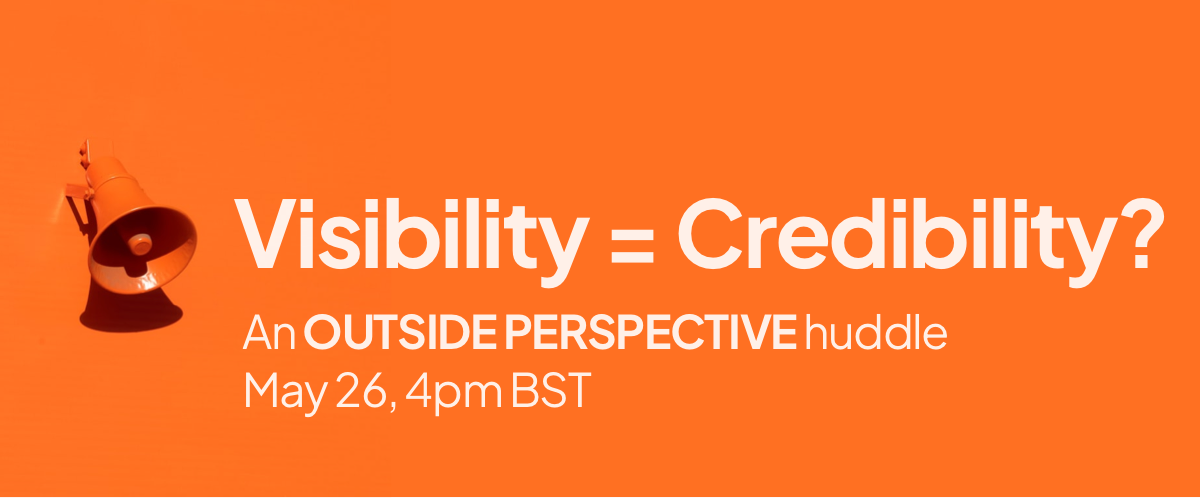
We’ve got a huddle coming up. Rescheduled from last month.
There's been an explosion in strategic commentary in recent years - with many independent (and perm) strategists spending significant time "thinking in the open".
Is a social content strategy essential for independent strategists? Does it build credibility and pipeline? Is it a frustrating distraction? Are all the busiest strategists actually just head down and doing work? Or is it a brilliant playground for debating topics that matter?
This 60 minute huddle has an open forum format, where everyone attending is asked to share a couple of minutes on their POV, and then a broader discussion between members.
This is an active participation session - so please come armed with your ideas. A summarised transcript will be made available after the call.
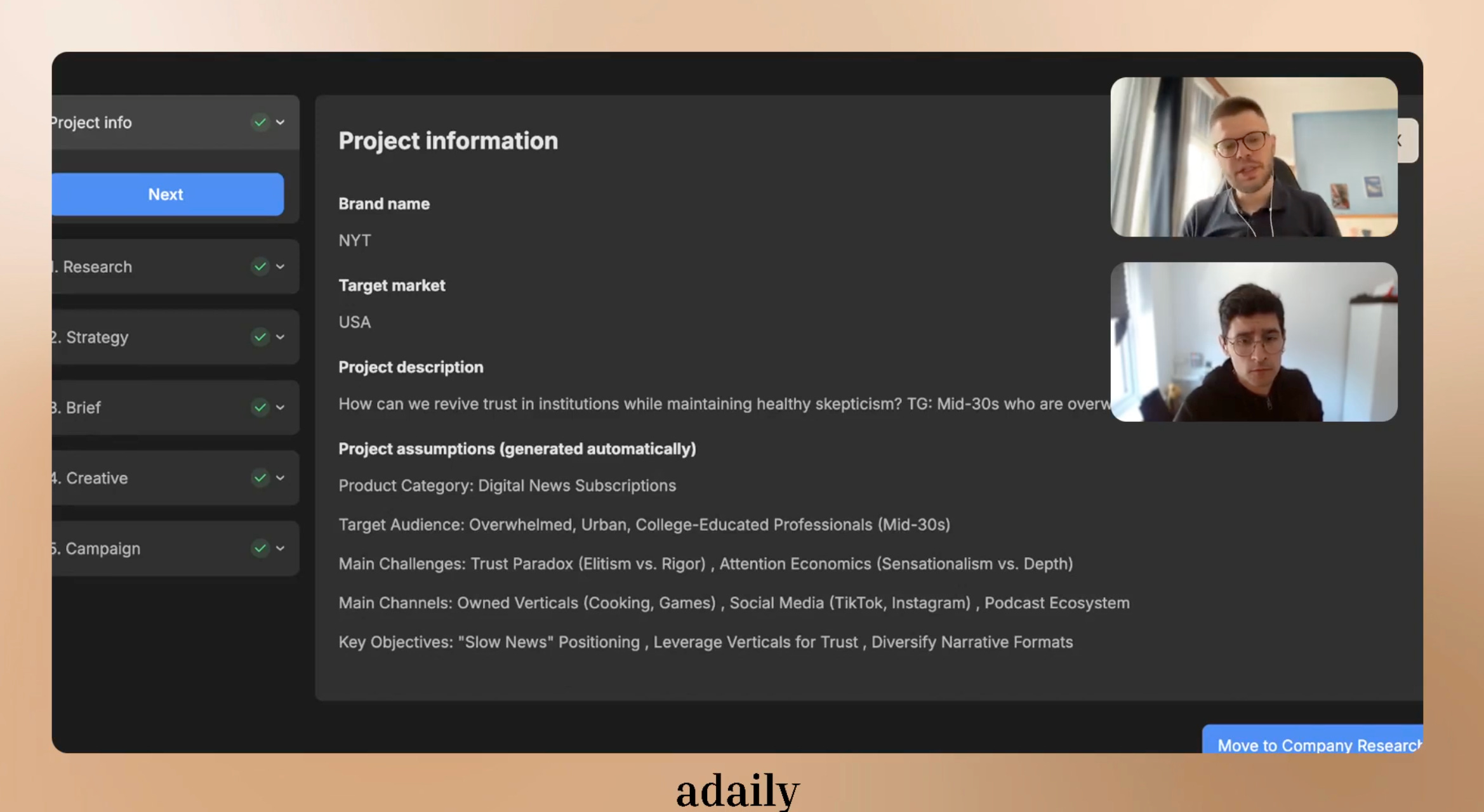
You might have seen ’s videos on adaily this week.
Outside Perspective community members now have discounted and preferential pricing for access the Adaily 2.0 - the AI Suite for Marketing. 2.0 handles full research, strategy and concepts for your projects.
It's not only tailored to the advertising domain, but also meant to overcome the biggest struggle with most AI tools: the requisition for prompting.
Adaily is built on 4,400+ award-winning campaigns and over 400 curated market reports, combined with targeted live web search - meaning the outputs aren't based on generic AI training data but on actual industry successes and trends.
If you’re a community member: details on accessing the exclusive pricing for monthly or weekly access, drop in to the Outside Perspective Slack community, or send me a DM.
If you’re an agency, client or permie: go direct to adaily here, and use the code OUTSIDEPERSPECTIVE for 20% off your first purchase + a 7 day free trial.
Share the love, friends x
We spoke to Gareth Price, strategy partner to the Global Clients team at Meta, who is behind a recent piece of work on understanding Gen Z, which we linked to a couple of weeks back.
Q. Gareth, tell us a little bit about the research - what assumptions or preconceptions have been challenged by the findings?
Working with BAMM, we undertook research with 18–24-year-olds - using a combination of mobile ethnography and a nationally representative survey - across Brazil, Germany, Japan, the UK, and the USA.
We found that connection remains core to why Gen Z uses Meta’s platforms but how and who they connect with is evolving. Increasingly they come to Instagram and Facebook to find content - from memes to video - to start and maintain conversations throughout the day in 1:1 or group chats on WhatsApp or Messenger. They also use our apps to connect with people they don’t know in real-life. From furnishing a new residence to meeting people with shared interests, Facebook Marketplace and Groups help them to connect to a new area when they start college or move for a new job. In addition to maintaining existing networks within their hometowns, Facebook plays an important role in connecting them to a local area.
Q. The work paints a picture of what I think we all knew already - that the world is made up of millions of tiny niches, rather than broad demographs, and even attitudes can sway with people effortlessly code-switching between channels. What do you think this means for audience definitions, and the ideas of ‘mass reach’, byron sharp, etc?
As always, it depends. The category you compete in is obviously key. From product to creative, in higher interest categories - like beauty and fashion - there are invariably more niches to play in. In lower-interest, higher household penetration categories like CPG that inevitably means greater aggregation of audiences.
Reaching all potential buyers remains key to success but adding layers of relevance to the creative - whether that’s partnering with creators in adjacent categories/areas or communicating multiple usage occasions - can help brands better resonate. The mobile environment is one of immediacy, in which you need to hook people and grab their attention quickly, so exploring different ways in (while maintaining the overarching idea) can help brands resonate with different segments. This is why we describe creative as the new targeting. You’re testing those different ways in without determining in advance which creative will work for which audience.
Q. The research suggests a complete flattening of the funnel - discovery, consideration, purchase, feedback - all can happen within a single moment or piece of content. What impact do you think that will have on comms planning?
It’s helpful to remind ourselves that funnels were born out of AIDA - that in itself was conceived of in the 19th century to help salespeople sell cash registers. Funnels have always functioned as more of a measurement framework than an accurate representation of messier consumer journeys.
The simultaneous rise of ecommerce (enabling buying to happen more seamlessly), addressable media (where companies can find the right audiences for specific products), and AI (shifting buying from audiences to outcomes) has arguably reduced its relevance for planning even further. In addition to putting greater emphasis on the importance of creative (as the new targeting), I think that makes consumer research (to establish those most relevant ways in and tying them to different category entry points) even more important too.
But it arguably has the biggest implications for product launches. Discovery is shifting away from intent (where I’m actively looking for a related product) to inspiration (where I’m open to ones relevant to my needs and interests). Particularly when the product is available for purchase online or is easy to add to a basket of goods (via solutions like collaborative ads).
Q. Dark social isn’t a new idea, but pebbling as communication is huge and only growing - are brands equipped to understand this hidden set of behaviours, and what might it mean for measurement?
I would argue the implications of pebbling - where Gen Z are constantly looking for content to express themselves - are more important when it comes to creative. When you’re using it to convey a mood or share your feelings on a subject - and you’re always on the lookout for content to achieve this - you invariably have a more intimate relationship with it on your phone. Which helps to explain why establishing ‘human connection’ is so powerful on our channels.
It’s rarely possible to break the fourth wall down if you’re slicing a TV ad up, so thinking social first and creating in the language of the platform becomes more important. Particularly as social is where that younger generation spend their time today. It’s always better to work with media habits than against them.
Q. It sounds like Gen Z are master manipulators of the algorithm, training it to their needs, rather than this idea of the algorithm leading our thinking - a form of self-curation, which also allows individuals to mask things they’re not wanting to see. Does this fly in the face of things like targeting, or will there be a tension between what an algorithm is pushing and what a consumer is wanting to see?
It flies in the face of targeting predetermined audiences with predetermined creative. At risk of repeating myself, I think that desire for individual relevance underlines the importance of having a degree of creative diversity. Whether that’s in the benefits you’re communicating, the usage occasions you’re showing, or the (creator) voices that bring the idea to life.
Once you’ve established the outcome you desire, and added any necessary restrictions (such as age for an alcohol brand), on our platforms, we see that providing AI with the freedom to determine which assets work with which audiences works best.
» Access the full report here.

» Matthew Hook on telling the story of the Alzheimer’s Society

» Kate Whalen and Ochuko Akpovbovbo on Gen-Z and work
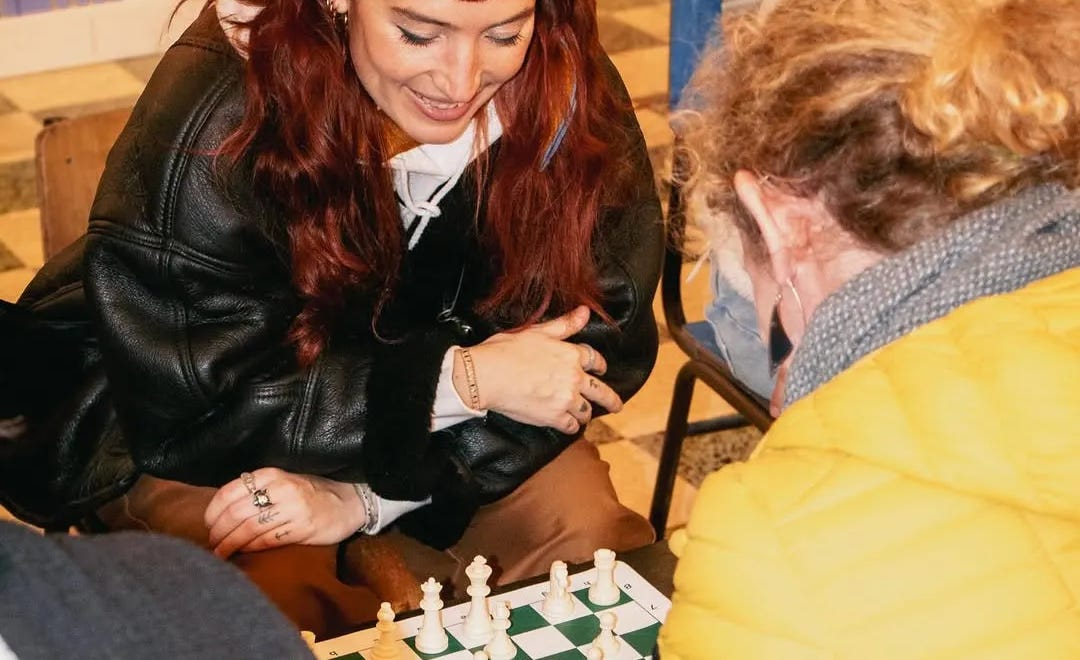
» Sibling Studio on the Brandification of belonging
» Terrifying data on AI and graduate recruitment, and a call to create.
» This breakdown of how Duolingo killed the owl is doing the rounds, but also a quite a bit of hating on the brand post their CEO’s take on “AI-first” shift. Was the owl’s death foreshadowing?
» Misconceptions around psychological safety - I’ve been exploring this a little for a piece of work I’m doing on freelancing and wellbeing. Can independents ever attain psychological safety at work?
» The invisible labour of ambition - the costs of trying to do things for yourself can often outweigh the benefits.
Wanna share your work, ideas or thinking with the community? - drop me a message, and I’ll pop it in the next issue. This is a scrapbook of our ideas, so please open up your brains.
Every week, I’ll try and introduce a member of the community, so we can get to know each other better. If you’re keen to show your face, let me know.

👋 Hi, I’m Simon Rutter.
I’m a senior communications consultant helping clients with every aspect of communications strategy and tactics, from leadership coaching to copywriting case studies.
I’ve worked with all sizes of businesses across a range of industries, including Tech, Pharma, FMCG, Mining, FS, Legal, Engineering, and Consulting.
I went freelance three years ago for two main reasons. One, I burnt out in my last two in-house roles. Second, I wanted more flexibility and freedom to be location-independent, especially as half of my family live in Bulgaria.
In the last year, my two favourite client projects were:
Wrote all the case studies for an FMCG client’s first integrated ESG Report. There was a new Chief Sustainability Officer and strategy to evidence across every one of its elements. I’m passionate about sustainability, so communicating this in a strategic, integrated, evidence-based way was a meaty and enjoyable challenge.
I supported a global consulting group on their brand positioning, product marketing, and content creation. The group has grown quickly via acquisition, so unified GTM messaging was critical. I’m most closely associated with the culture and coaching consulting parts of the group, and as a communicator and coach myself these areas fascinate me. Identifying, codifying, and communicating the group’s point of difference has been intense and rewarding.
In the future I’d like to do more work in the ESG space, and I also want to get involved in new sectors – nuclear, defence, aerospace, even the police. These are all fascinating to me and I think they all have a need for better communications!
Things I’m loving at the moment:
Watching – Loving Race Across The World on BBC. This is the only ‘reality’ show my wife and I watch, as we love travel and experiencing new cultures. It does a great job of showcasing countries and people, and taking you on an emotional journey, without it being manipulative. There’s something genuine and hopeful about it, which we all need more of right now!
Reading – I just finished 1312: Among the Ultras: A journey with the world’s most extreme fans by James Montague. I’m a huge football fan, and this book was as good as I hoped it would be. If you’re interested in terrace culture, this is a must.
Running – I’ve been a runner for 25 years, but recently I’ve been hampered by consistent and persistent injuries. I’m just coming back after a few enforced months doing no running or exercise of any kind, so I’m enjoying the climb back to fitness.
Say hello to Simon on LinkedIn, or via the Community.
Briefs discovered and curated from across the stratosphere.
Promote your brief - or tell us if you’ve found work via the project.
Freelance Strategy Director with tech exp (Global)
https://outsideperspective.co/gigs/20250516-wo.html
Open Call: Freelance Brand Strategists (UK)
https://outsideperspective.co/gigs/20250516-waf.html
Strategy Director (Contract) (London,UK)
https://outsideperspective.co/gigs/20250516-vccp.html
Senior Social Analyst (London,UK)
https://outsideperspective.co/gigs/20250516-social.html
Head of Marketing, Vintage (12-month FTC) (London,UK)
https://outsideperspective.co/gigs/20250516-penguin.html
Strategy Director / Team Lead (Maternity Cover) (Berlin,DE)
https://outsideperspective.co/gigs/20250516-kemmler.html
Freelance Senior Strategist (Berln,DE)
https://outsideperspective.co/gigs/20250516-kemmler-2.html
freelance cultural strategist (London,UK)
https://outsideperspective.co/gigs/20250512-publicis.html
freelance creative strategy directors with experience across digital and social (London,UK)
https://outsideperspective.co/gigs/20250512-pivotal.html
If you’re a business looking to work with independent strategy people - or want to build out your own virtual community of freelance strategists, across a range of disciplines, get in touch.
Whether it’s sharing your brief directly with our community (no more endless lists of comments on LinkedIn), building a bench, or dropping your freelancers in to our space so they can also benefit from the community - we’re open to collaborate. Drop me a note.
That’s all for this week.
mk✌️
Get our Community Edition delivered to your inbox every week.